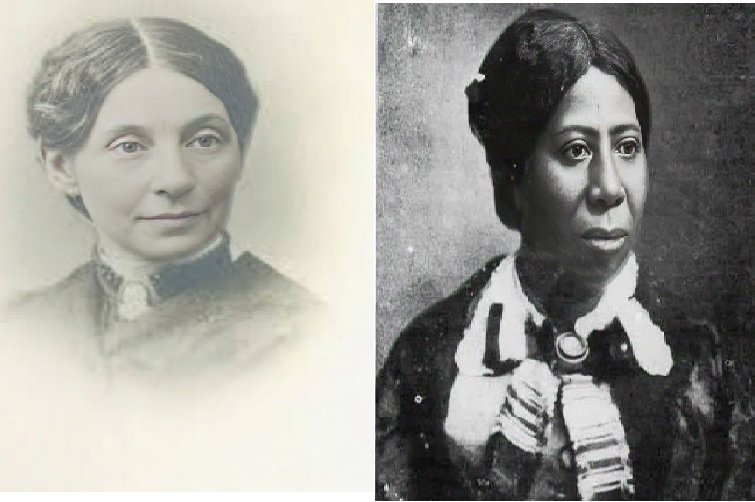
The remarkable women who stood beside one of America’s most influential abolitionists – one who helped him escape slavery, the other who preserved his legacy
Two Marriages, One Remarkable Legacy
Douglass was married for 44 years to Anna Murray, a free Black woman who helped him escape slavery. After her death, he sparked controversy by marrying Helen Pitts, a white woman 20 years his junior who worked as his secretary. Both relationships tell us much about the man and the turbulent times he lived through.
Anna Murray Douglass
1813 – 1882
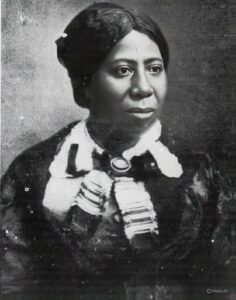
Born free in Maryland, Anna worked as a housemaid and saved enough money to help Frederick escape slavery in 1838. She sold a feather bed to finance his journey north.
They married just 11 days after his arrival in New York, with Anna giving him the surname “Johnson” initially for protection (he later chose “Douglass”).
While Frederick traveled extensively for the abolitionist cause, Anna managed their household, raised their five children, and took in boarders to supplement their income.
She was described as practical, resourceful, and deeply private—a stabilizing force in Douglass’s turbulent life.
Helen Pitts Douglass
1838 – 1903
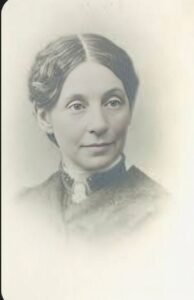
A graduate of Mount Holyoke Female Seminary, Helen was a suffragist and abolitionist from a prominent New York family.
She began working as a clerk in Douglass’s office when he was Recorder of Deeds for Washington, D.C., and they developed a close intellectual partnership.
Their 1884 marriage—just 18 months after Anna’s death—caused outrage among both white and Black communities. Helen’s family disowned her, and Black newspapers criticized Douglass for “abandoning” his race.
Helen fiercely defended their union, famously retorting: “Love came to me, and I was not afraid to marry the man I loved because of his color.”
A Controversial Second Marriage
When 66-year-old Douglass married 46-year-old Helen Pitts in 1884, the reaction was explosive. The Washington Critic called it “a national calamity.” Even Douglass’s children were reportedly cool to the union initially.
But Helen proved to be more than just a controversial spouse. She became Douglass’s intellectual companion, discussing politics, literature, and the women’s suffrage movement they both championed. After his death, she worked tirelessly to preserve his legacy, successfully campaigning to make Cedar Hill (their home) a historic site.
Key Moments in Their Lives
Anna Murray helps Frederick Bailey escape slavery by providing sailor’s clothes, money, and papers. They marry in New York on September 15.
While Frederick becomes a nationally known abolitionist speaker, Anna manages their growing household in Massachusetts and later Rochester, New York, often taking in boarders to support the family.
Anna Murray Douglass dies after a long illness on August 4. Frederick is devastated, writing of her as “the anchor and stay of my young life.”
Frederick Douglass marries Helen Pitts on January 24, creating a national scandal. They travel extensively in Europe to escape the controversy.
Frederick Douglass dies on February 20. Helen dedicates the rest of her life to preserving his legacy and making Cedar Hill a memorial.
The Legacy They Preserved
Both Anna and Helen played crucial roles in Douglass’s life at different stages. Anna provided the foundation—the practical support, family stability, and unwavering partnership that allowed a former slave to become a national leader. Helen provided the intellectual companionship and legacy preservation that ensured his work would endure.
Interestingly, both women were committed activists in their own right. Anna hosted Underground Railroad activities in their Rochester home and supported the abolitionist movement despite her preference for privacy. Helen was an active suffragist who worked with Susan B. Anthony and Elizabeth Cady Stanton.
Their stories remind us that behind great historical figures often stand partners whose contributions are equally worthy of remembrance.